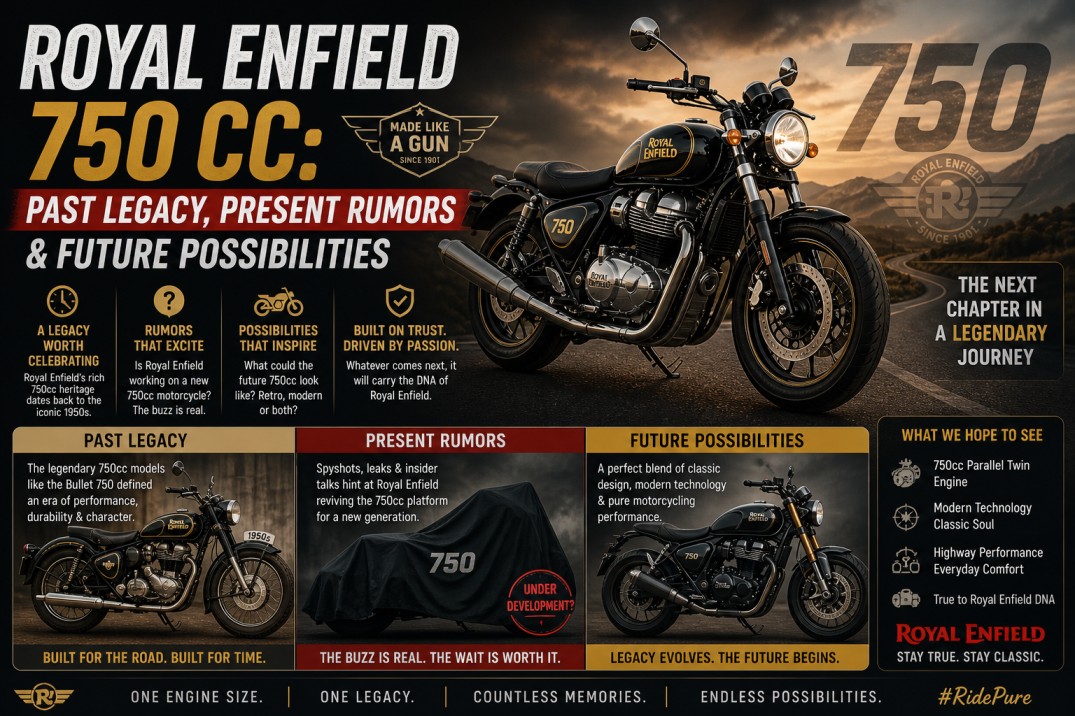
Introduction: Is a Royal Enfield 750 CC Finally Returning?
The phrase royal enfield 750 cc sparks instant curiosity among motorcycle enthusiasts. For decades, Royal Enfield has been associated with long-stroke singles and, more recently, the highly successful 650cc parallel twins. But what about a 750cc machine?
Interestingly, this isn’t a new idea.
Royal Enfield has built 750cc motorcycles in the past. And today, industry speculation suggests the brand may be exploring larger-displacement engines again as it expands globally.
So is a Royal Enfield 750 cc just a nostalgic memory—or a glimpse into the future?
Let’s explore both the legacy and the possibilities.
The History of Royal Enfield 750 CC Motorcycles
Before diving into rumors, it’s important to understand that Royal Enfield already had 750cc motorcycles in its lineup—long before the modern 650 twins.
The Interceptor 750 (1960s)
The most iconic historical example is the Royal Enfield Interceptor 750, introduced in the 1960s in the UK.
- 736cc parallel-twin engine
- Designed primarily for the American market
- Built to compete with Triumph and BSA twins
- Known for strong mid-range performance
According to archival material on the official Royal Enfield heritage pages, the Interceptor 750 was among the most powerful British twins of its time.
However, Royal Enfield’s UK operations shut down in 1970, ending production of large-displacement twins.
For decades after, the company focused almost entirely on single-cylinder Bullets in India.
The Modern Era: Why 650cc Became the Sweet Spot
Fast forward to 2018.
Royal Enfield launched the Interceptor 650 and Continental GT 650, marking its global comeback in the twin-cylinder category. These bikes were widely praised by publications like Motorcycle News (MCN) and Cycle World for offering accessible performance at competitive pricing.
Current 650 Platform Specs:
| Specification | Royal Enfield 650 Twin |
|---|---|
| Engine | 648cc parallel twin |
| Power | ~47 bhp |
| Torque | 52 Nm |
| Gearbox | 6-speed |
| Top Speed | ~170 km/h |
The 650 platform became Royal Enfield’s global success story.
So why didn’t they go straight to 750cc?
Strategic Reason:
650cc offers:
- Affordable insurance in many countries
- Beginner-friendly power
- Manageable weight
- Lower emissions complexity
It was a smart global positioning move.
Why a Royal Enfield 750 CC Makes Strategic Sense Today
Now here’s where things get interesting.
Royal Enfield has publicly stated its ambition to grow in Europe, North America, and Southeast Asia. According to annual reports from Eicher Motors, the company’s parent organization, global expansion remains a key priority.
In Western markets, riders often prefer:
- 700–900cc motorcycles
- Higher cruising speeds
- Stronger highway performance
A royal enfield 750 cc motorcycle could:
- Bridge the gap between 650 twins and larger middleweights
- Compete with bikes like the Kawasaki Z650RS or Yamaha XSR700
- Offer stronger highway capability without entering liter-bike territory
Is Royal Enfield Developing a 750 CC Engine?
While there’s no official confirmation as of 2026, industry speculation suggests Royal Enfield is experimenting with expanded twin platforms.
Several auto publications have hinted that the existing 650 twin could be bored or stroked to around 750cc for:
- Increased torque
- Improved highway cruising
- Better load-carrying capacity for touring
If Royal Enfield follows its current engineering philosophy, a 750cc version would likely prioritize:
- Smooth power delivery
- Strong mid-range torque
- Classic styling
- Competitive pricing
Not aggressive sport performance.
Hypothetical Royal Enfield 750 CC Specs (Projected)
If Royal Enfield launches a 750cc twin based on the current platform, here’s a realistic projection:
| Feature | Expected Specification |
|---|---|
| Engine | ~750cc parallel twin |
| Power | 55–60 bhp |
| Torque | 60–65 Nm |
| Gearbox | 6-speed |
| Cooling | Air-oil or liquid-assisted |
| Electronics | Dual-channel ABS, traction control (basic) |
| Riding Modes | Possibly minimal or none |
Royal Enfield tends to keep electronics simple to preserve its mechanical character.
Where Would a Royal Enfield 750 CC Fit in the Lineup?
Let’s compare existing displacement tiers:
| Segment | Models | Target Rider |
|---|---|---|
| 350cc | Classic, Hunter, Meteor | Beginners & urban riders |
| 450cc | Himalayan 450 | Adventure riders |
| 650cc | Interceptor, Continental GT, Super Meteor 650 | Mid-weight enthusiasts |
| 750cc (Potential) | ??? | Long-distance & global riders |
The 750cc could serve as:
- A more powerful Interceptor
- A touring-focused cruiser
- A modern retro roadster
- Even a larger scrambler
The possibilities are broad.
Personal Insight: Would 750 CC Change the Royal Enfield Experience?
Having ridden the 650 twins extensively, I can say this:
They’re smooth.
They’re charming.
But at sustained highway speeds above 120 km/h, you sometimes wish for a little more headroom.
A royal enfield 750 cc motorcycle could solve that without compromising the brand’s identity.
However, Royal Enfield’s strength isn’t raw horsepower—it’s accessibility and emotional connection.
If a 750cc model becomes too heavy, too expensive, or too tech-heavy, it risks losing what makes Royal Enfield special.
The sweet spot would be:
More torque.
Same simplicity.
Minimal electronic intrusion.
Competition Landscape
If launched, a Royal Enfield 750 CC would compete with:
- Kawasaki Z650RS (649cc)
- Yamaha XSR700 (689cc)
- Triumph Trident 660
- Honda CB750 Hornet
Here’s how it might compare:
| Bike | Power | Character |
|---|---|---|
| Royal Enfield 750 (Projected) | 55–60 bhp | Retro torque-focused |
| Yamaha XSR700 | ~73 bhp | Sporty twin |
| Honda CB750 Hornet | ~90 bhp | High-performance |
| Kawasaki Z650RS | ~67 bhp | Balanced retro |
Royal Enfield would likely compete on:
- Price
- Styling
- Simplicity
- Emotional appeal
Not outright performance.
The Risk Factor
Launching a Royal Enfield 750 CC isn’t without risk.
Challenges include:
- Stricter emission regulations (Euro 5+, BS6 Stage 2)
- Increased development cost
- Maintaining reliability
- Avoiding overlap with 650 twins
According to global emissions standards discussed by organizations like the European Environment Agency, compliance costs rise with engine displacement and output.
Royal Enfield must balance performance with affordability.
Could the 750 CC Be Electric Instead?
Here’s a wildcard perspective.
Royal Enfield has confirmed electric motorcycle development. Some speculate that instead of increasing displacement, the brand may focus on electrification for performance gains.
But for traditional enthusiasts, the charm of a thumping or twin-cylinder engine remains irreplaceable.
A 750cc combustion model would cater directly to that loyal base.
Final Thoughts: Will We See a Royal Enfield 750 CC?
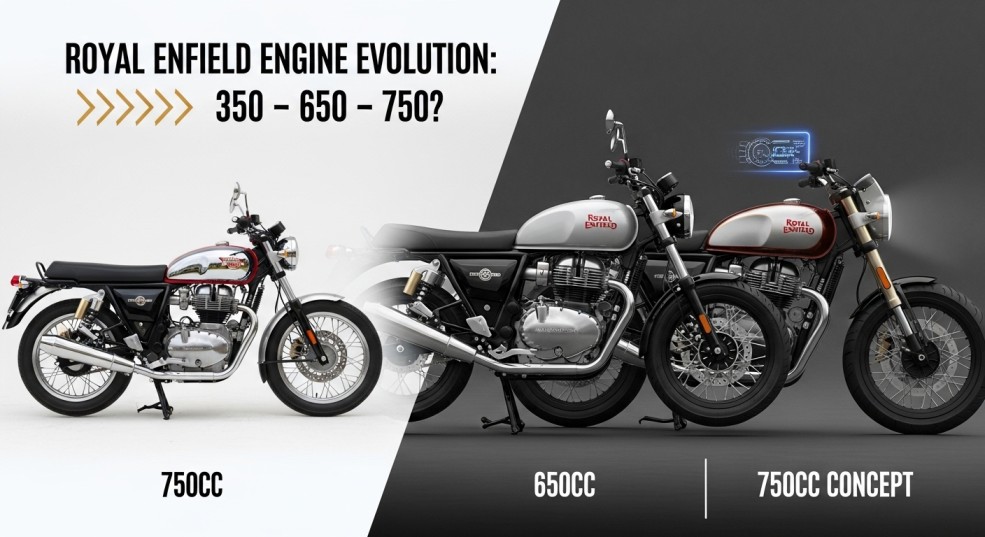
The Royal Enfield 750 cc concept isn’t just fantasy—it’s historically rooted and strategically plausible.
Here’s what we know:
- Royal Enfield has built 750cc bikes before.
- The global market is ready for larger mid-weight retros.
- The 650 platform provides a strong foundation.
If launched thoughtfully, a 750cc Royal Enfield could:
- Enhance highway comfort
- Expand global appeal
- Strengthen the brand’s mid-size dominance
But if over-engineered, it risks diluting the simplicity riders love.
Ultimately, the success of a Royal Enfield 750 CC will depend on one thing:
Can it deliver more power without losing soul?
What’s Your Opinion?
Would you upgrade from a 650 to a Royal Enfield 750 CC?
Or do you think 650cc is already perfect for the brand?
👇 Share your thoughts in the comments.
If you enjoyed this deep dive, explore our reviews of the Interceptor 650 and Super Meteor 650—and subscribe for the latest updates on upcoming Royal Enfield launches. 🏍️