Introduction: Why the Bullet Trials 350 Still Sparks Curiosity
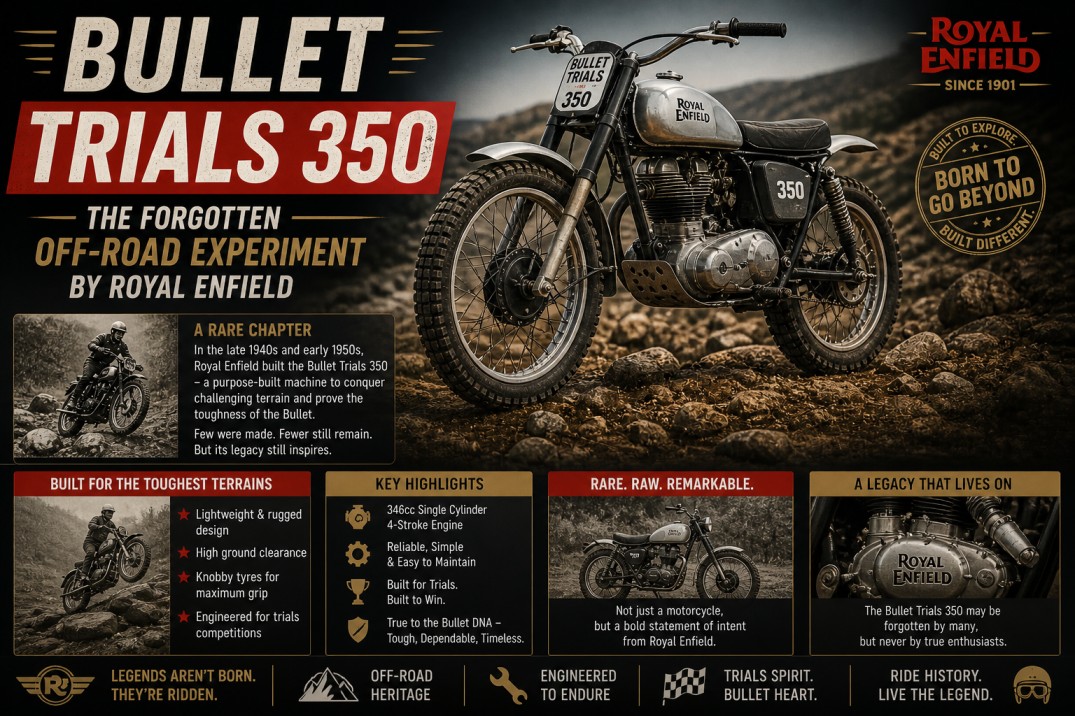
The Bullet Trials 350 wasn’t just another Royal Enfield variant—it was a nostalgic nod to the brand’s rugged past. When Royal Enfield launched it in 2019, it surprised enthusiasts by reviving the “Trials” badge, inspired by the company’s participation in off-road competitions as far back as the 1950s.
For many riders, it felt like a “what if?” motorcycle.
What if the classic Bullet had real off-road credibility?
What if retro design met mild adventure capability?
Although production was short-lived, the Bullet Trials 350 remains one of the most intriguing chapters in Royal Enfield’s modern history. In this deep dive, we’ll explore its origins, specs, real-world performance, comparisons, and whether it makes sense as a used buy today.
The Heritage Behind the Bullet Trials 350
To understand the Bullet Trials 350, you need to go back to Royal Enfield’s competition roots. The brand famously competed in off-road trials events in the UK during the mid-20th century. According to historical archives shared on the official Royal Enfield global website, the company supplied motorcycles for military use and competitive events, building a reputation for durability.
The 2019 Bullet Trials 350 was inspired by the 1949 Royal Enfield Bullet Trials machine—a stripped-down, go-anywhere version of the standard Bullet.
But here’s the key insight:
The modern version was more of a tribute than a true trials bike.
Bullet Trials 350: Quick Specifications
Let’s break down what the motorcycle offered.
| Specification | Bullet Trials 350 |
|---|---|
| Engine | 346cc, single-cylinder, air-cooled |
| Power | ~19.8 bhp |
| Torque | 28 Nm |
| Gearbox | 5-speed |
| Kerb Weight | ~192 kg |
| Ground Clearance | ~135 mm |
| Fuel Tank | 13.5 liters |
| Brakes | Disc (front & rear), dual-channel ABS |
| Tires | Dual-purpose |
The engine was the same long-stroke unit used in the traditional Bullet 350 of that era.
What Made the Bullet Trials 350 Different?
At first glance, it looked like a standard Bullet with cosmetic tweaks. But look closer.
Key Distinguishing Features:
- Single seat setup (no traditional pillion seat)
- Rear luggage rack in place of passenger seat
- Raised exhaust for mild off-road practicality
- Handlebar brace pad
- Chunkier, dual-purpose tires
- Distinctive color schemes
It visually hinted at scrambler DNA, although it wasn’t a full-fledged scrambler like some modern builds.
📸 Suggested Image: Side-by-side comparison of Bullet 350 and Bullet Trials 350.
Engine & Performance: Classic Long-Stroke Feel
The Bullet Trials 350 used Royal Enfield’s older UCE (Unit Construction Engine) platform. Unlike the smoother J-series engine found in newer bikes like the Hunter 350, this motor had a raw, mechanical character.
Riding Experience
In city riding:
- Strong low-end torque
- Classic thumping exhaust note
- Heavy clutch feel compared to modern REs
On highways:
- Comfortable cruising at 80–90 km/h
- Noticeable vibrations at higher speeds
The long-stroke motor delivered that old-school Bullet charm—but refinement wasn’t its strongest suit.
According to reviews from platforms like Autocar India, the UCE engine had character but lagged behind competitors in smoothness and efficiency.
Off-Road Capability: Style Over Substance?
Here’s where things get interesting.
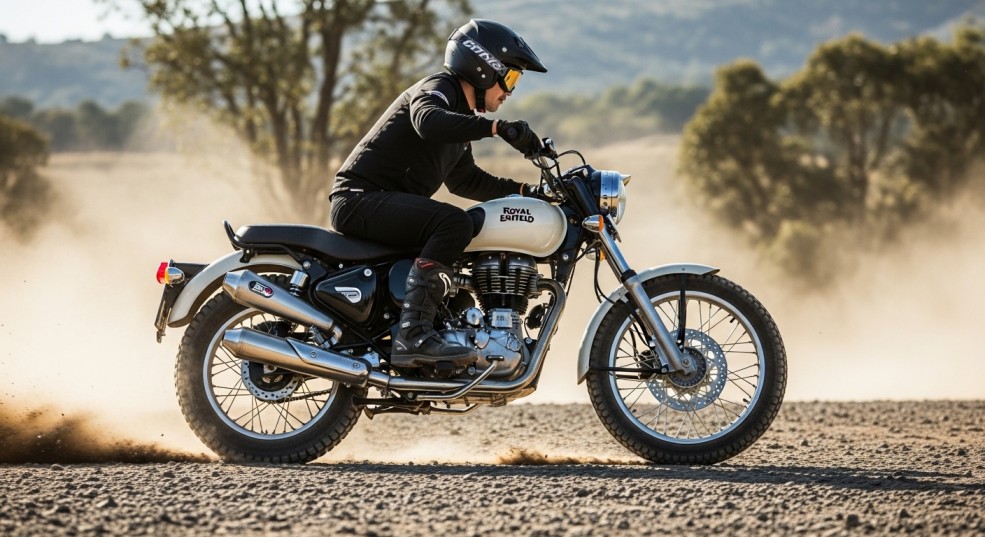
Despite the “Trials” badge, the Bullet Trials 350 was not a hardcore off-road machine.
Why?
- High kerb weight (~192 kg)
- Limited suspension travel
- Modest ground clearance
- Street-biased chassis geometry
Yes, the raised exhaust helped avoid scraping on uneven terrain.
Yes, the tires provided better grip on loose surfaces.
But compared to modern adventure bikes—even lightweight ones—it wasn’t built for aggressive trails.
Think:
- Dirt paths
- Gravel roads
- Mild rural exploration
Not:
- Enduro tracks
- Technical hill climbs
This is a crucial distinction often misunderstood by buyers.
Bullet Trials 350 vs Standard Bullet 350
Here’s a clear comparison:
| Feature | Bullet Trials 350 | Standard Bullet 350 (UCE era) |
|---|---|---|
| Seat Setup | Single seat | Dual seat |
| Exhaust | Raised | Standard low-mounted |
| Tires | Dual-purpose | Road-biased |
| Weight | Slightly heavier | Slightly lighter |
| Purpose | Retro scrambler vibe | Classic roadster |
Verdict:
Mechanically similar.
Visually distinct.
Functionally only marginally more off-road capable.
If you already owned a Bullet 350, the upgrade was more about styling than performance.
Why Was the Bullet Trials 350 Discontinued?
The Bullet Trials 350 had a relatively short market run. Several factors contributed:
- Transition to BS6 emission norms (India, 2020)
- Phase-out of the older UCE engine
- Introduction of the new J-platform 350 engines
Royal Enfield shifted focus toward modernizing its lineup, leading to models like:
- Classic 350 (J-series)
- Meteor 350
- Hunter 350
The Bullet Trials 350 quietly exited as the brand evolved.
According to industry reports from Eicher Motors, Royal Enfield’s strategy has been to modernize while retaining heritage appeal—something the Trials 350 symbolized during a transitional phase.
Real-World Ownership Experience
From conversations with owners and rider forums, here’s what stands out:
What Owners Love:
- Unique design
- Collectible appeal
- Classic thump
- Attention on the road
Common Complaints:
- Vibrations at higher speeds
- Heavy weight in slow traffic
- Limited practicality (no pillion seat)
- Spare parts becoming less common
The single-seat setup was polarizing. Some loved the minimalist, rugged look. Others missed the flexibility of carrying a passenger.
Is the Bullet Trials 350 a Good Used Buy in 2026?
If you’re considering one today, here’s what to evaluate.
✅ Buy It If:
- You want a collectible Royal Enfield
- You love retro aesthetics
- You enjoy mild off-road exploration
- You appreciate classic engine character
❌ Avoid If:
- You want modern refinement
- You prioritize fuel efficiency
- You plan frequent two-up riding
- You expect serious off-road performance
Used pricing varies depending on condition and region, but well-maintained examples are increasingly seen as niche collectibles rather than daily commuters.
The Cultural Significance of the Bullet Trials 350
Here’s a fresh perspective:
The Bullet Trials 350 wasn’t about dominating the adventure segment. It was about storytelling.
It told a story of:
- Heritage
- British trials racing history
- Rugged individuality
In a motorcycle industry increasingly dominated by aggressive styling and tech-heavy features, the Bullet Trials 350 felt refreshingly analog.
It appealed to emotion more than logic.
And sometimes, that matters more.
Design Legacy: Did It Influence Future Models?
Indirectly, yes.
The popularity of retro scrambler-style builds has influenced modern motorcycle design globally. According to market analysis from organizations like the Motorcycle Industry Council, heritage and neo-retro segments continue growing due to strong lifestyle branding.
Royal Enfield later introduced models like the Scram 411, which better executed the urban-scrambler concept with practical capability.
In that sense, the Bullet Trials 350 was a stepping stone.
“Bullet Trials 350: Tribute vs True Off-Roader”
Final Thoughts: A Tribute More Than a Trail Warrior
The Bullet Trials 350 occupies a fascinating space in Royal Enfield’s timeline.
It wasn’t the most capable.
It wasn’t the most refined.
It wasn’t the most practical.
But it was memorable.
It represented a bridge between old-school Royal Enfield mechanics and the brand’s modern reinvention.
If you see one today, you’re looking at a limited chapter of experimentation—one that celebrated heritage while hinting at future innovation.
Over to You
Would you buy a Bullet Trials 350 today?
Do you see it as a collectible or just a cosmetic variant?
👇 Share your thoughts in the comments.
If you enjoyed this deep dive, explore our detailed reviews of the Classic 350, Hunter 350, and Meteor 350 to see how Royal Enfield has evolved. And don’t forget to subscribe for more in-depth motorcycle insights. 🏍️