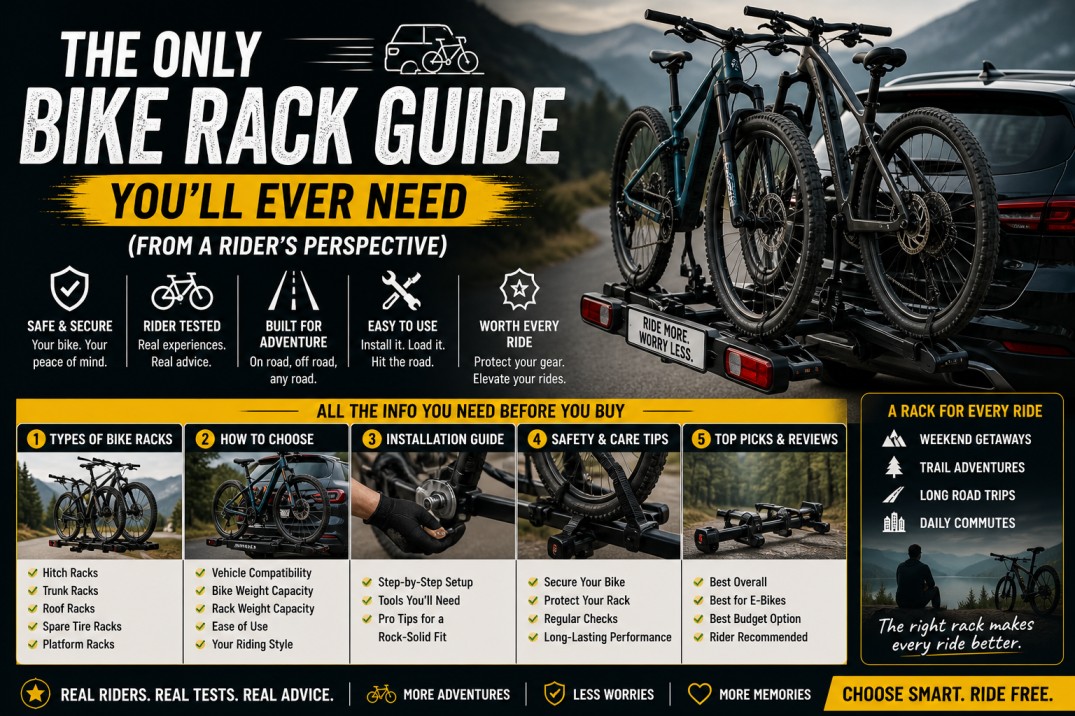
You’ve spent months researching the perfect bicycle. You’ve obsessed over geometry, groupsets, and tire clearance. But there’s one critical component most cyclists treat as an afterthought—until they’re standing in a parking lot with a scratched frame and a broken taillight. Bike Rack
I learned this the hard way on a trip to Ladakh three years ago. A cheap trunk-mounted bike rack decided to embrace my carbon frame halfway up a mountain pass. The repair bill cost more than a premium rack would have.
Whether you’re a weekend warrior, a daily commuter, or an e-bike enthusiast, choosing the right carrier changes how often you actually ride. Let’s cut through the marketing noise and break down exactly what matters.
Why Your Choice of Carrier Defines Your Riding Life
Most people buy a rack based on price or what fits their car today. That’s a mistake.
The right system should:
- Match your vehicle’s capability (not just the hitch size)
- Accommodate your heaviest bike
- Survive your typical driving conditions
- Make loading so easy you never skip a ride
According to the National Highway Traffic Safety Administration (NHTSA), improperly secured loads cause thousands of accidents annually. Your rack isn’t an accessory—it’s a safety system.
The Three Main Types of Bike Racks (And Who They’re For)
There’s no universal “best.” There’s only “best for you.” Here’s how the three dominant styles stack up in real-world use.
1️⃣ Hitch-Mounted Racks: The Gold Standard
These slide into your vehicle’s receiver hitch (1.25″ or 2″). They come in two flavors: platform (tray) and hanging.
Platform (Tray) Style
Bikes sit on wheel trays, secured by a ratcheting arm or wheel straps. No frame contact.
Why riders love them:
- Easiest loading (lift only inches off ground)
- Fits weird frames (step-through, full suspension, fat tires)
- Highest weight capacity (critical for e-bikes)
- Most stable at highway speeds
Drawbacks:
- Heavy (30–50 lbs)
- Expensive (₹30k–₹80k+)
- Requires hitch receiver
Brands like Thule and Yakima dominate this category for a reason—their anti-wobble bolts and lifetime warranties are worth the premium.
Hanging Style
Bikes hang by the top tube from pivoting arms.
Pros:
- Lighter and cheaper
- Fold compactly
- Good for 2–3 traditional bikes
Cons:
- Frame contact = potential scratches
- Poor for step-through frames (need adapter bar)
- Sway more on rough roads
- Lower weight limits (often 35 lbs/bike)
Verdict: If you own any electric bike or modern mountain bike, spend extra for a platform rack. Your frame will thank you.
2️⃣ Roof-Mounted Racks: The Purist’s Choice
These clamp to crossbars on your roof. Fork-mount (remove front wheel) or upright (frame/wheel clamp).
Why Choose Roof?
- Full rear access (tailgate opens freely)
- Best aerodynamics with single bike
- Most secure (locked to crossbars, crossbars locked to car)
- Doesn’t block license plate or lights
The Hidden Costs
- Fuel economy penalty: 10–25% MPG drop at highway speeds (tested by Consumer Reports)
- Loading difficulty: Lifting 25+ lbs overhead repeatedly
- Clearance amnesia: Garages, drive-thrus, parking structures become hazards
- Theft exposure: Bikes visible and accessible
Best for: Road cyclists with lightweight bikes, low roof lines, and garage height awareness.
3️⃣ Trunk/Hatch-Mounted Racks: The Budget Entry Point
Straps hook onto sedan trunk or SUV hatch edges.
Reality Check
- Weight limits strict (often 35 lbs total)
- Contact points scratch paint despite padding
- Blocks rear view and hatch access
- Not for carbon frames or e-bikes
- Straps stretch and degrade over time
Only consider if:
- You drive a rental or leased car
- Bikes are lightweight (sub-20 lbs)
- Occasional use only
- Budget under ₹10k
Brands like Saris make the most reliable strap racks, but physics is physics.
Comparison at a Glance
| Feature | Hitch Platform | Hitch Hanging | Roof Mount | Trunk Mount |
|---|---|---|---|---|
| E-bike Ready | ✅ Excellent | ⚠️ Marginal | ❌ No | ❌ No |
| Load Height | Low (knee) | Low (waist) | High (overhead) | Medium |
| Rear Access | ⚠️ Tilt/fold | ⚠️ Swing away | ✅ Full | ❌ Blocked |
| Aero Impact | Low | Low | High | Medium |
| Security | High | Medium | High | Low |
| Price Range | ₹35k–₹80k | ₹15k–₹35k | ₹20k–₹50k* | ₹5k–₹12k |
| Vehicle Required | Hitch receiver | Hitch receiver | Crossbars | Any sedan/SUV |
*Roof price excludes crossbars (add ₹10k–₹25k)
Six Questions That Reveal Your Perfect Rack
Skip the spec sheets. Answer these instead:
1. What’s the heaviest bike you’ll carry?
- Under 14 kg (30 lbs): Any rack works
- 14–20 kg (30–45 lbs): Hitch platform or heavy-duty hanging only
- Over 20 kg (45 lbs): Hitch platform mandatory
2. How many bikes, how often?
- 1–2 bikes weekly: Hitch platform
- 3–4 bikes monthly: Hitch hanging or roof
- 4+ bikes occasionally: Consider a trailer
3. What’s your vehicle’s weak link?
- No hitch, no rails: Trunk mount (temporary) or install hitch
- Low garage clearance: Avoid roof
- Tiny hatchback: Hitch extends rear—measure parking spots
4. Frame styles in your fleet?
- Step-through, full-sus, fat tires: Platform only
- Traditional diamonds: Any style works
5. Security needs?
- Quick coffee stops: Cable lock sufficient
- Overnight hotel parking: Integrated locks + hitch lock + cable
- High-theft areas: Roof or hitch with locking trays
6. Budget including installation?
- Hitch installation: ₹3k–₹8k if not factory-equipped
- Crossbars: ₹8k–₹20k for quality towers/bars
- Factor these in before comparing rack prices
The E-Bike Factor: Why Old Rules Don’t Apply
Electric bikes changed everything. At 20–30 kg each, they:
- Exceed most hanging rack limits
- Crush trunk rack straps
- Make roof loading dangerous for solo riders
- Demand platform trays with wheel straps (not frame clamps)
If an e-bike is in your future—or your partner’s—buy a hitch platform rack rated 60+ lbs per tray. The Thule EasyFold XT and Yakima StageTwo are benchmarks here.
Pro tip: Remove batteries before transport. Saves 3–4 kg and protects your most expensive component from vibration and theft. Bosch eBike Systems officially recommends this.
Installation & Compatibility Traps
Hitch Classes Matter
- Class I/II (1.25″): Light duty, 2 bikes max, no e-bikes
- Class III/IV (2″): Heavy duty, required for platform racks
Don’t assume your factory hitch is Class III. Check the sticker or manual.
Receiver Rise/Drop
Your hitch height vs. rack height affects ground clearance. Adjustable shanks solve this.
Integrated Hitches (Hidden)
Some SUVs (Ford Bronco, newer Subarus) hide the receiver behind a bumper cutout. Verify rack compatibility—some need adapter kits.
Security: The Layered Approach
No rack is theft-proof. But layers deter thieves:
- Hitch lock (locks rack to vehicle)
- Integrated bike locks (lock bikes to rack)
- Cable lock (backup, locks frames together)
- Locking skewers (wheels/seatpost)
- Parking strategy (well-lit, cameras, backed against wall)
I use a Kryptonite Evolution chain as my final layer when overnighting.
Maintenance: The Forgotten Factor
A neglected rack becomes a hazard. Monthly:
- Torque hitch bolt to spec
- Lubricate pivot points and locks
- Inspect straps for UV damage
- Check tire straps for cracks
- Wash salt off in winter
Platform trays with replaceable parts (Thule, Yakima, and 1UP USA) last decades. Cheap racks are disposable.
Personal Takeaways After 50,000+ km of Bike Transport
After years of hauling everything from 7 kg road bikes to 28 kg cargo e-bikes across the Himalayas and city streets:
Buy once, cry once. A quality hitch platform rack holds resale value. You’ll sell it for 60% of the price in 5 years. Cheap racks go to the landfill.
The tilt mechanism is non-negotiable. Being able to access your trunk with bikes loaded changes how you use your vehicle.
Ramp integration matters. For e-bikes, a folding ramp (like on the Yakima HangOver or Thule EasyFold) saves your back.
Two-bike racks are the sweet spot. Four-bike racks extend dangerously far rearward. Get a 2-bike + add-on if needed.
Test before buying. Visit a shop. Load your actual bike. Feel the ergonomics.
Internal Resources for Indian Cyclists
If you’re building your cycling ecosystem, we’ve got you covered:
- 👉 Electric bike transport deep dive: Bike Rack for Electric Bikes
- 👉 City commuting essentials: Best Hybrid Bikes in India
- 👉 Maintenance guides: Chain Lubrication Mistakes to Avoid
Final Decision Framework
| Your Situation | Recommended Solution |
|---|---|
| 1–2 bikes, mixed types, have hitch | Hitch platform (Thule/Yakima/1UP) |
| 3+ traditional bikes, budget conscious | Hitch hanging (Saris/Thule) |
| Road bikes only, low roof, garage aware | Roof fork-mount (Thule/RockyMounts) |
| Rental car, occasional use | Trunk mount (Saris Bones) |
| E-bike owner | Hitch platform, 60+ lb rating, ramp |
| No hitch, no rails, frequent use | Install hitch (Curt/EcoHitch) + platform |
🚴 Ready to Stop Worrying and Start Riding?
The right bike rack disappears from your consciousness. You just drive, ride, and repeat.
Have a horror story or triumph with a particular rack? Share it in the comments—real rider feedback beats marketing specs every time.
And if this guide saved you from a costly mistake, explore more no-nonsense cycling wisdom at https://thebikestylish.in/
Your bike deserves a first-class ticket. Give it one. 🚲